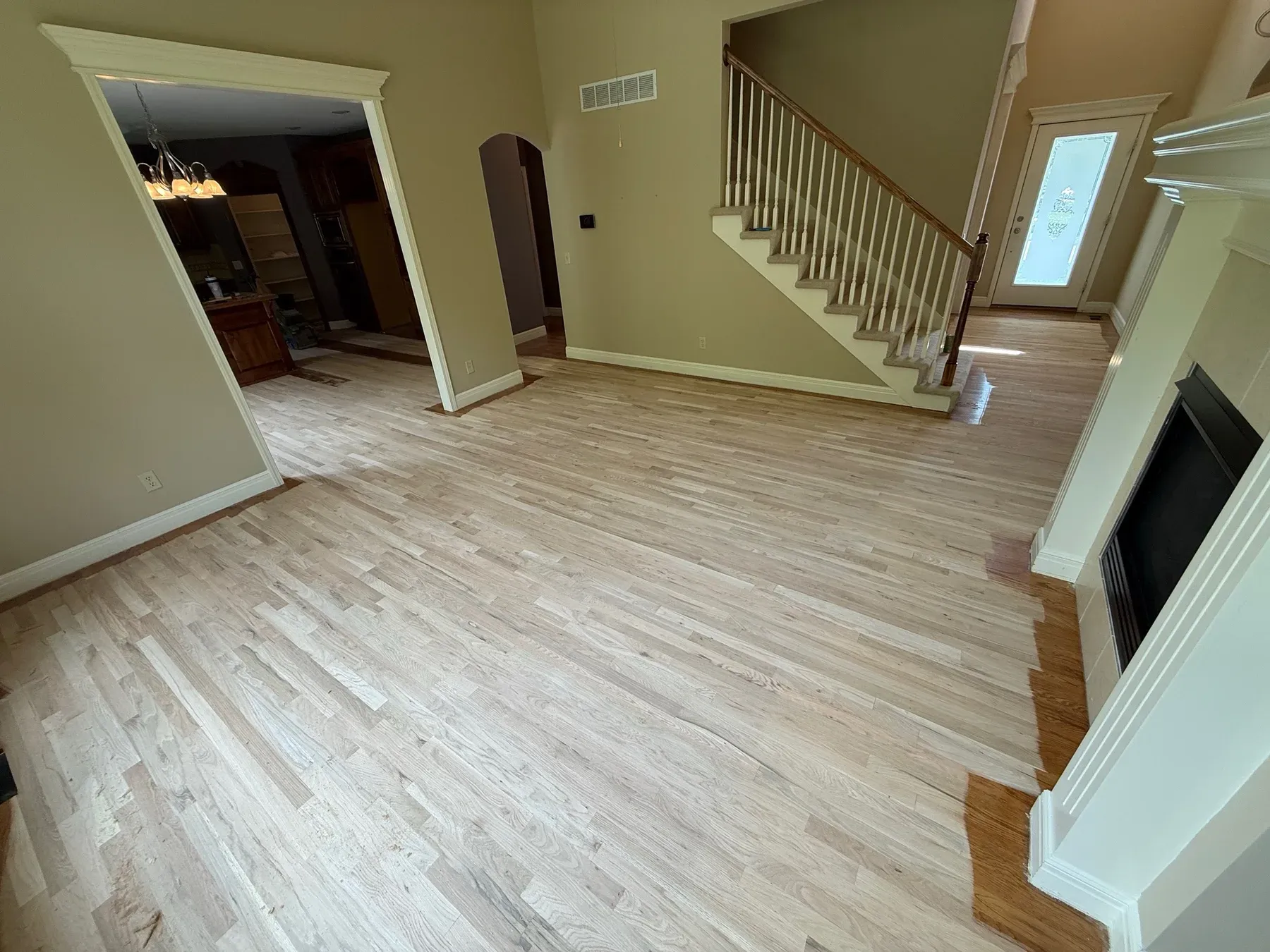
Many older Kansas City houses have oak on the main floor and something else upstairs. Bedrooms, closets, back halls, kitchens and attic rooms were often floored in pine, because it was cheaper and nobody expected it to be the showpiece. Decades later, the carpet comes up and the homeowner wants to know if that floor can look good.
Usually it can. But refinishing pine floors is a different job from refinishing oak, and most of the disappointing pine floors we see were sanded, stained and finished as if they were oak. Here is what is different.
Which Pine Do You Have?
"Pine" covers a wide range of wood, and the difference matters:
- Southern yellow pine and heart pine. Denser and more resinous, with strong contrast between the soft and hard parts of each growth ring. Old heart pine, cut from the center of long-lived trees, ages to a deep amber or orange-red and is the most durable pine floor you are likely to find.
- White pine and other softer pines. Paler, lighter and much softer. Eastern white pine is less than a third as hard as red oak on the Janka scale. It dents under a dropped toy and marks under a chair leg.
- Pine that was never meant to be seen. Some houses have pine subfloor or utility-grade boards that were always covered. They can sometimes be refinished, but they may have wide gaps, square-edged boards, nail holes and patches that were never planned around.
We can usually tell which you have from a look at the boards and a corner where the finish is worn. It shapes every decision that follows.
Is There Enough Wood to Sand?
The first question on any old floor is how much wood is left above the tongue, or above the nails on face-nailed boards. A floor that has been sanded before, or one with boards that have cupped or worn thin in traffic lanes, may not have much to spare. We check at a floor register or a threshold before quoting a full sanding. If the floor is too thin, there are still options, and restoring old and damaged hardwood floors covers them.
Face nails are common in old pine and need to be set below the surface before a sander goes over them, or they tear the paper and leave shiny streaks in the wood.
Sanding Pine Without Ruining It
Each growth ring in pine has a soft band and a hard band. An aggressive sander cuts the soft wood faster than the hard, which leaves a wavy, dished surface you can feel under bare feet and see in low light. Pine also loads sandpaper with resin, especially heart pine, which can burn and streak the surface if nobody is watching.
Done right, pine gets a gentler grit sequence than oak, frequent paper changes, and careful edge work so the perimeter does not end up gouged deeper than the field. Hardwood floor sanding covers the grit sequence in general, and pine is where taking it slowly matters most.
There is also a choice to make about the color you already have. Old pine has darkened under its finish over many decades, and that warm patina is often why people love it. A full sanding cuts through to fresh, pale wood, which will darken again with time but not right away. On a floor in decent shape, a lighter sanding that removes the old finish without going as deep keeps more of the aged color. We will tell you which approach your floor can take.
Stain on Pine Is a Gamble
Pine absorbs stain unevenly. The soft parts of the grain soak it up and the hard parts resist it, so a stain that looks even on oak can come out blotchy and striped on pine. It is a classic disappointment on DIY pine refinishes.
When a client wants color, a conditioner coat and a light, carefully tested stain can work. But most pine looks best with no stain at all, just a clear finish that lets the wood's natural color warm over time. And pine should never be stained to match the oak downstairs. It will not match, and it is better treated as its own floor. Our staining guide covers how different woods take color.
Wide Boards and Gaps
Old pine floors are often wider than old oak strip, and wider boards move more with the seasons. In a Kansas City winter, when the heat is running and the air is dry, the gaps between pine boards can open up noticeably and then close again in the humid summer.
That seasonal movement is why we do not fill every gap in a pine floor. Filler pushed into a gap that opens and closes will crack and pop out. Gaps that stay open year round are a different matter, and the wider ones can be filled with thin slivers of matching wood glued into place. Why gaps open in your hardwood floors every winter explains what is seasonal and what is not.
Finishes That Suit Pine
No finish makes pine as hard as oak. The finish protects the surface from wear and moisture, but a dent in the wood underneath dents the finish with it. So the goal is a finish that ages gracefully with some character:
- Sheen. Satin or matte. A glossy finish on a soft floor shows every dent and scuff.
- Oil-based polyurethane. Its natural amber tone suits pine and deepens that warm, old-house color.
- Water-based polyurethane. Keeps fresh pine paler for longer, if a lighter look is what you want.
- Hardwax oil. A natural, low-sheen look that is easy to spot-repair, at the cost of more regular upkeep.
Water-based or oil-based polyurethane compares the two most common choices in detail.
Living With a Pine Floor
A refinished pine floor will collect dents and marks faster than oak. Most people who choose to keep their pine accept that as part of its character, the same way they accept the knots and the color. Felt pads on every chair and table leg, a doormat at each entry, and a recoat before the finish wears through keep it looking good for a long time.
If the floor has damaged or missing boards, matching old pine is harder than matching oak, because new pine is a different color and often a different width. Salvaged boards from a closet or another part of the house are often the best source. Patching an old floor without a visible seam covers how we blend repairs.
Getting It Right
We refinish old pine and oak floors in older homes across the metro, from Kansas City neighborhoods like Brookside and Waldo to North Kansas City and St. Joseph. Our hardwood floor refinishing page covers the full process, and our dustless system keeps the old plaster walls of these houses cleaner during the work. If you have found pine under your carpet, get a free estimate and we will tell you straight what it can become.
Get a Free Estimate
Have a floor you want looked at? We give honest, no-pressure estimates across the Kansas City metro.