St. Joseph has one of the deepest collections of historic houses in the region. The city documents a long list of National Register districts, Museum Hill, Hall Street, Cathedral Hill, Robidoux Hill and Patee Town among them, and Museum Hill alone takes in more than 240 contributing buildings put up roughly between 1860 and 1942. Italianate, Second Empire and Queen Anne houses, and the Gilded Age mansions along Hall Street, still have much of the woodwork they were built with, floors included.
That makes hardwood floor refinishing in St. Joseph a different job from refinishing a 1990s floor in the suburbs. An old floor can almost always be brought back, but it has to be read first. How it was installed, what it was finished with and how many times it has already been sanded decide what the work looks like.
What Is Actually Under Your Feet
Houses from this era rarely have one floor throughout. It is common to find several kinds in the same house:
- Oak in the formal rooms. Parlors, dining rooms and front halls were where the money went, and they often have narrow oak strip, sometimes quartersawn, sometimes with a contrasting border or a simple inlaid band around the room.
- Pine in the working rooms. Kitchens, back halls, back stairs and upstairs bedrooms were often laid in pine, usually wider than the oak. Old-growth pine is a beautiful floor, but it is much softer than oak and it carries a century of dents.
- Oak laid over pine. In some houses a later owner laid thin oak strip right over the original pine. You find out when a register comes up and there are two floors in the cross section.
- Patches and additions. Bathrooms, kitchens and back porches that were added or rebuilt over the decades, each with whatever flooring was standard at the time.
Knowing which is which matters, because each one sands, stains and repairs differently.
How Much Wood Is Left
Every sanding takes a little wood off the top. A tongue-and-groove floor can only be sanded down to the tongue before the boards start to split and the nails show, so the real question on a century-old floor is how many sandings it has already had.
We check by pulling a floor register or looking at a board end at a threshold, where the wood left above the tongue can be measured. Thin overlay strip, the kind laid over pine, has less to give from the start. Our guide to how many sandings a century-old floor has left walks through the check in detail. When the wood is thin, the job is planned around taking off as little as possible, and sometimes a light screen and recoat is the right answer instead of going to bare wood.
Face Nails, Cut Nails and Square Heads
A lot of older floors, especially wide pine, were face-nailed: nailed straight down through the top of the board rather than hidden through the tongue. Those nail heads sit right in the path of the sander. Before any sanding, every one of them gets set below the surface, or the machine will catch them, tear the paper and gouge the floor around them. On a large old house that alone is real work, and it is one reason historic floors take longer than newer ones.
Original cut nails and square heads are part of the look on an old pine floor. Most people want them to stay visible, so they are set, not pulled and filled.
Shellac, Varnish and Wax
Before modern polyurethanes, floors were finished with shellac, varnish and paste wax, and many were waxed for decades on top of whatever was underneath. Those layers gum up sandpaper fast and have to be cut through completely, because a modern finish will not bond over leftover wax. Old wax hides in the board seams and comes back to haunt a new finish if it is not removed.
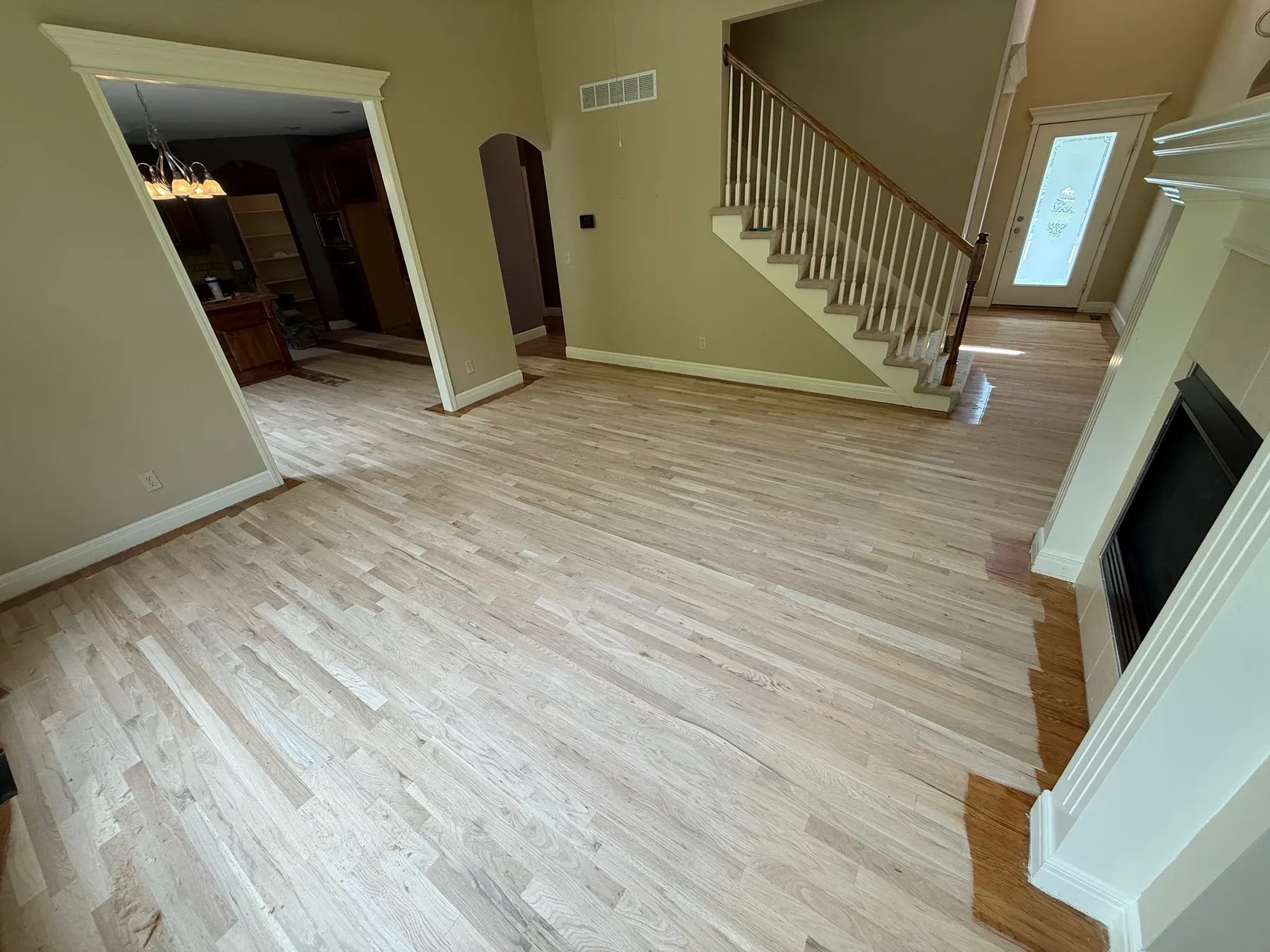
Most owners want something tougher than wax, so the floor goes to bare wood and gets a modern finish. Water-based or oil-based polyurethane compares the two families. On old pine and oak, the warmth of an oil-based finish is often what makes the floor look its age in a good way.
Painted Borders and Lead
Many Victorian floors had a painted or stained border around the edge of the room, where the area rug did not cover the wood. In the decades since, that paint has often been covered, chipped or painted over again. Paint in a house built before 1978 may contain lead, and federal rules require renovation work that disturbs it to follow lead-safe practices. That changes how the edges of an old floor are handled and how dust is contained and cleaned up, so it is something to plan for at the start, not discover halfway through.
Our dustless refinishing setup collects dust at the machine, which helps in any old house where the plaster, trim and furniture are as old as the floor.
Repairs Come First
A century of plumbing changes, furnace moves and walls taken out leaves its marks. Before sanding, we deal with:
- Holes and old patches where a floor furnace, a radiator pipe or a wall used to be.
- Pet and water stains that went deep into the wood. Light ones can sand out. Dark ones mean replacing those boards.
- Loose and split boards, especially along old face-nailed pine.
- Mismatched patches where a previous repair used the wrong species or width.
Replacement boards on a historic floor have to match species, width and thickness, and old floors are often not a size anyone mills today. Salvaged boards from a closet or a removed wall are the best match, and new material can be milled to size when there is nothing to salvage. Patching an old floor without a visible seam covers how new boards are woven in so the repair disappears after sanding.
Gaps Are Part of the Story
Wide old boards, pine especially, open up in the dry winter months and close in the humid summer. A floor that has lived through more than a century of Missouri winters and summers has earned some of its gaps. Packing every one with filler usually fails, because the filler cracks and falls out when the boards swell and shrink again. We fill where it will hold and leave normal seasonal movement alone. Why gaps open every winter explains what is normal and what is not.
Color That Suits the House
Freshly sanded old oak and pine can look startlingly pale, nothing like the warm amber floor people remember. Much of that warmth came from the old finish. A clear oil-based finish brings a lot of it back on its own. If you want a stain, test it on your own sanded boards, because old wood takes stain differently than new wood and pine can blotch. Our staining guide covers how samples are done.
When Something Is Worth Preserving
Some floors in St. Joseph's grand homes have parquet borders, inlaid bands or patterns that are part of the house's history. Those deserve the lightest touch: careful sanding or hand work at the border, matched repairs and no shortcuts. If your house is in a historic district and you are working with a preservation program or tax credits, check what they require before work starts so the finish and repairs fit.
Getting Started
We refinish, repair and restore historic hardwood in St. Joseph, from Museum Hill to Hall Street and the neighborhoods around them. See hardwood floor refinishing in St. Joseph and hardwood floor repair in St. Joseph for the service detail, and restoring old and damaged hardwood floors for what to expect when carpet comes up. Get a free estimate and we will measure what is left of your floor and tell you straight what it can take.
Get a Free Estimate
Have a floor you want looked at? We give honest, no-pressure estimates across the Kansas City metro.