Johnson County was built from the state line outward, and you can read it in the houses. Overland Park traces back to the subdivisions William B. Strang Jr. began platting in 1905, but it did not incorporate until 1960, when it had about 28,000 residents, and it had passed 111,000 by 1990. Leawood's original Leawood Estates subdivision was platted in 1945 and the city incorporated in 1948. Olathe is the newest story of the three by housing stock: it grew fast from the 1980s, passed 100,000 residents around 2001, and the 2020 census counted more than 141,000.
For a flooring contractor those dates are a map. A question about hardwood floor refinishing in Overland Park, Leawood or Olathe is really a question about which era of house you are standing in, because each one has a different floor and needs a different job.
The Older Core: Oak Under the Carpet
The streets around downtown Overland Park, the original north side of Leawood and the east side of Shawnee are full of post-war ranches and split-levels. That was the era when oak strip flooring went down as a matter of course and was carpeted over a decade or two later. Much of it is still there, protected by the carpet that hid it.
Pull back a corner in a bedroom closet before you plan anything. If there is oak, you are very likely looking at a solid floor that has been sanded rarely or never, which makes refinishing it one of the best returns available on the house. Expect tack-strip holes around the edges, some staining where pets or plants sat, and the occasional plywood patch where a floor furnace or wall used to be. All of that is normal, and restoring old and damaged hardwood floors covers what comes back.
These are the same floors we wrote about just north of here in Prairie Village, Fairway and Westwood, and the advice in that guide applies house for house. Our hardwood floor refinishing in Overland Park page covers the service.
The Subdivision Years: A Floor in Three Pieces
Further south and west, the houses date from the 1980s through the 2000s: the big Overland Park subdivisions, Lenexa neighborhoods like Manchester Park and Falcon Ridge, and most of Olathe. The main floor in many of these houses came in three pieces. Oak in the entry and dining room, tile or vinyl in the kitchen and breakfast area, and carpet in the family room.
Thirty years on, the oak has an amber finish that has yellowed, the tile is dated, and the carpet is done. The job people ask for is to make it all one floor, and it is one of the most satisfying jobs we do.
- The tile and carpet come out. Tile removal is the loud, dusty part, and what it leaves behind has to be brought flush with the subfloor under the oak. Flooring removal covers what each material involves.
- New oak gets laced into the old. The new boards match the existing species, width and thickness, and they are woven into the old floor at staggered lengths so no straight seam marks where the kitchen used to start. Matching new hardwood to an existing floor explains why that matters.
- Everything is sanded and finished together. Old boards and new take the same color and the same finish in one pass, and the house ends up with one continuous floor.
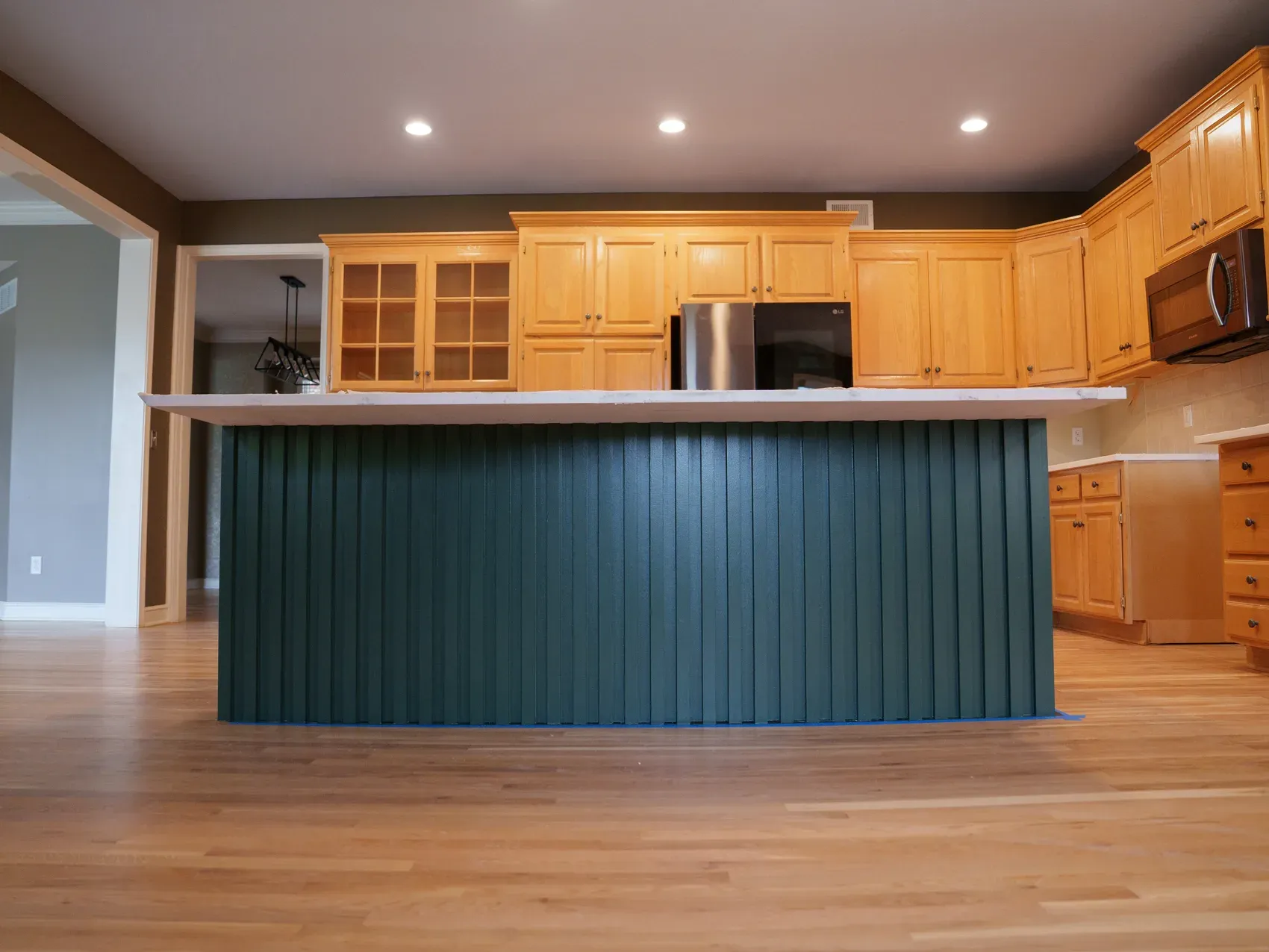
If wood in the kitchen makes you nervous, hardwood floors in kitchens covers what actually holds up. The sequencing is the thing to get right: new boards go in before the sanding, not after, and the flooring contractor should be talking to whoever is doing the cabinets. Our hardwood floor installation in Olathe and installation in Lenexa pages cover the install side.
Changing the Color of a 1990s Floor
Most of the oak in these subdivisions is red oak under an oil-based finish, and the most common request we hear is some version of "anything but orange." Once the old finish is sanded away, the color is a fresh decision. Natural, warm brown and dark walnut tones all work well on red oak. Very pale and cool gray colors are harder, because red oak's pink undertone comes through, so those need careful sampling on your own sanded boards before anyone commits.
The clear coat matters as much as the stain here. A water-based finish stays clear instead of drifting back toward amber, which is usually the point of the whole exercise. We compare the options in water-based or oil-based polyurethane, and the staining guide covers how colors get tested.
If the finish is only dull and you are happy with the color, none of this is needed. A screen and recoat renews the surface for a fraction of the cost. Our hardwood floor recoating in Overland Park page covers that service.
The Large Custom Homes
South Leawood communities like Hallbrook and Mission Hill Estates, and the newer estates in southern Overland Park, are a different conversation. Leawood was planned in the J.C. Nichols mold, with big lots and a high standard of upkeep, and the floors are held to that standard too.
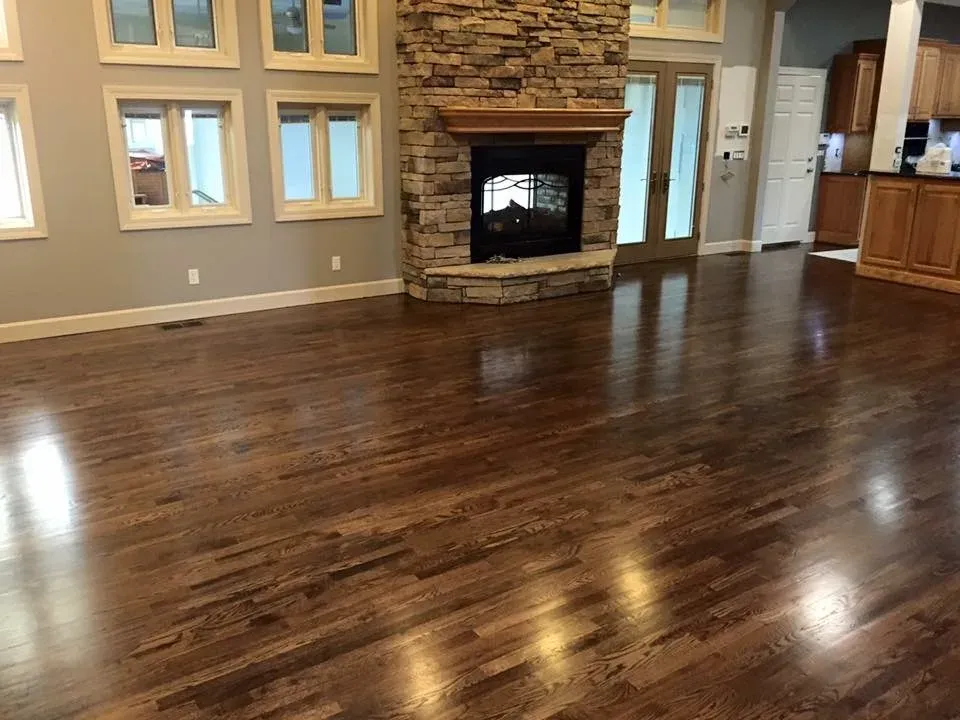
In these houses the wood tends to run through most of the main level, often in wider planks, and the rooms are large and bright. That combination is unforgiving. Low sun across a long run of floor shows every sanding mark and every lap in the finish, so the last sanding passes and the coating technique matter more here than anywhere. How hardwood floor sanding actually works explains what separates a flat floor from a wavy one.
Wide planks also move more with the seasons than narrow strip does, which makes steady indoor humidity part of owning the floor. And when a floor in one of these homes is engineered rather than solid, the thickness of its wear layer decides whether it can be sanded at all. Check can engineered hardwood be refinished before assuming either way. For new floors and additions at this level, what custom hardwood floors actually means covers where the money goes, and our hardwood floor refinishing in Leawood page covers the service.
Stairs and the Upstairs Landing
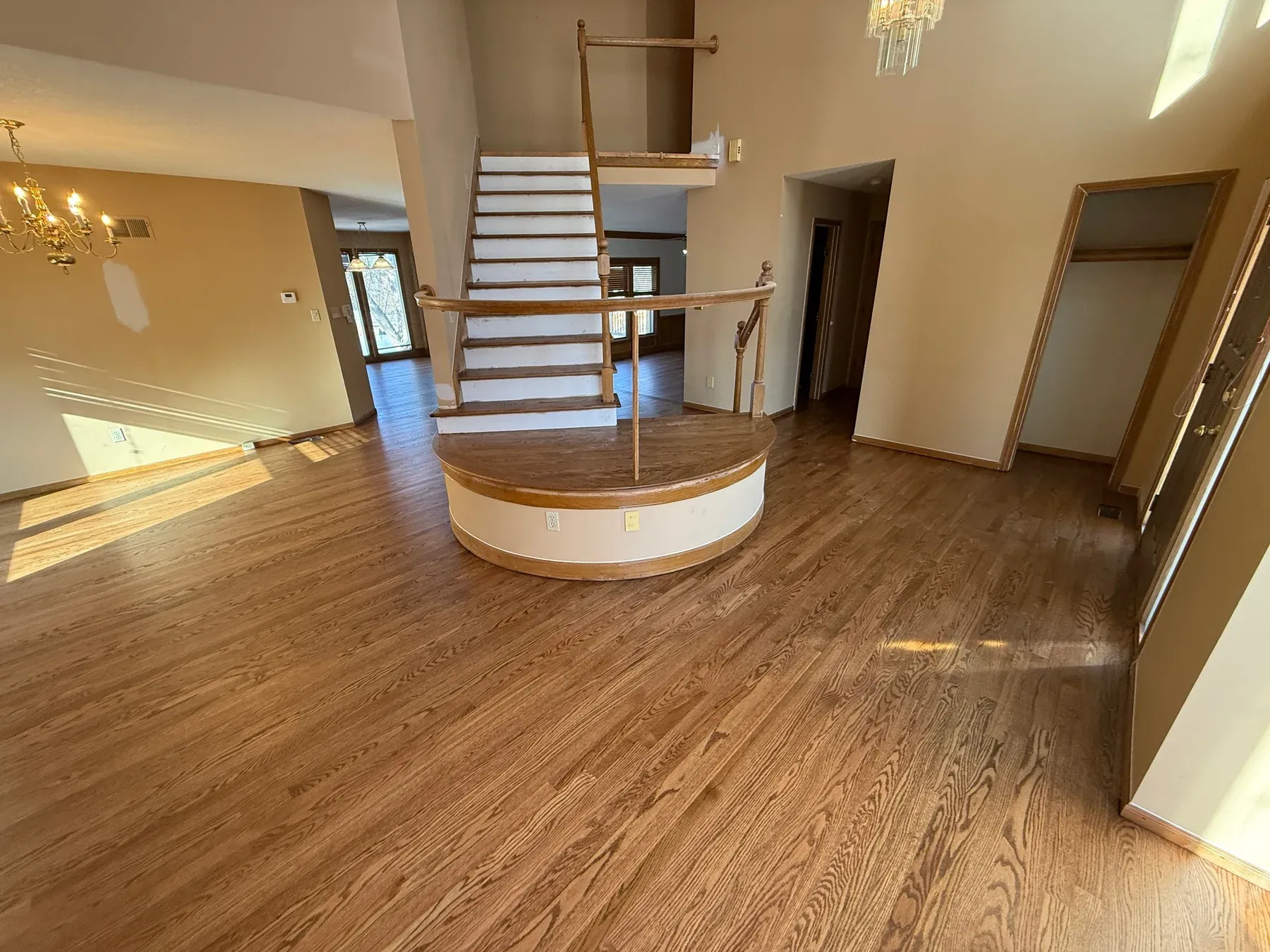
The two-story houses of the subdivision years nearly all have the same staircase: carpeted treads, stained oak rails, and an upstairs landing that overlooks the entry, much like the one pictured at the top of this page. Two jobs come up constantly.
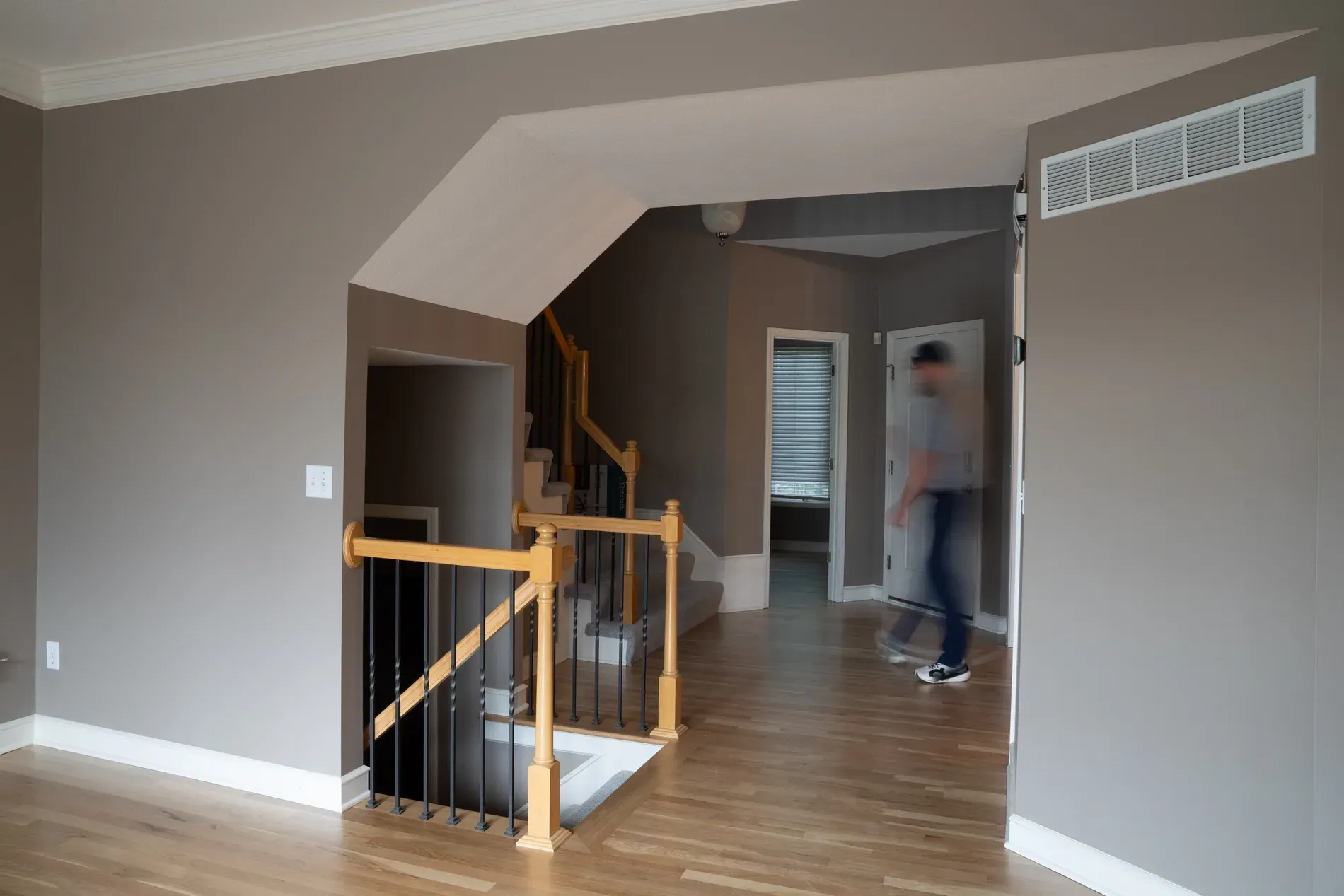
The first is converting the carpeted stairs to hardwood treads that match the refinished floor below, which the hardwood stairs guide walks through. The second is the railing. A golden oak handrail beside a newly refinished floor in a different color looks like it belongs to another house. Rails can be refinished to match, and wood balusters can be swapped for iron, as covered in what a stair railing update really involves. Our custom staircases and handrails service and hardwood stairs in Overland Park page cover that work.
Walkout Basements
Finished lower levels are common across the county, and they sit on concrete. Solid hardwood cannot be nailed to a slab and is a poor match for below-grade conditions in this climate. If you want wood downstairs, engineered flooring rated for installation over concrete is the answer, after the slab has been tested for moisture. The solid or engineered guide covers the choice.
Refinishing Before You Sell
Buyers in Johnson County notice floors, and worn traffic lanes in the entry and kitchen are among the first things they see. If the wood is sound, a refinish or even a recoat before listing is usually a far better spend than replacing the floor or covering it. Neutral colors and a satin sheen suit the widest range of buyers. The thing to plan for is time, because the finish needs to cure before furniture, rugs and showings, so call well before the listing date rather than the week of.
Where We Work in Johnson County
We refinish, repair and install hardwood across Overland Park, Leawood, Olathe, Lenexa and Shawnee, and our Shawnee and Lenexa guide covers those two cities. Whether you have found oak under the bedroom carpet, want a three-piece main floor turned into one, or have a large floor that needs to be flawless, get a free estimate and we will tell you straight what your floor needs.
Get a Free Estimate
Have a floor you want looked at? We give honest, no-pressure estimates across the Kansas City metro.