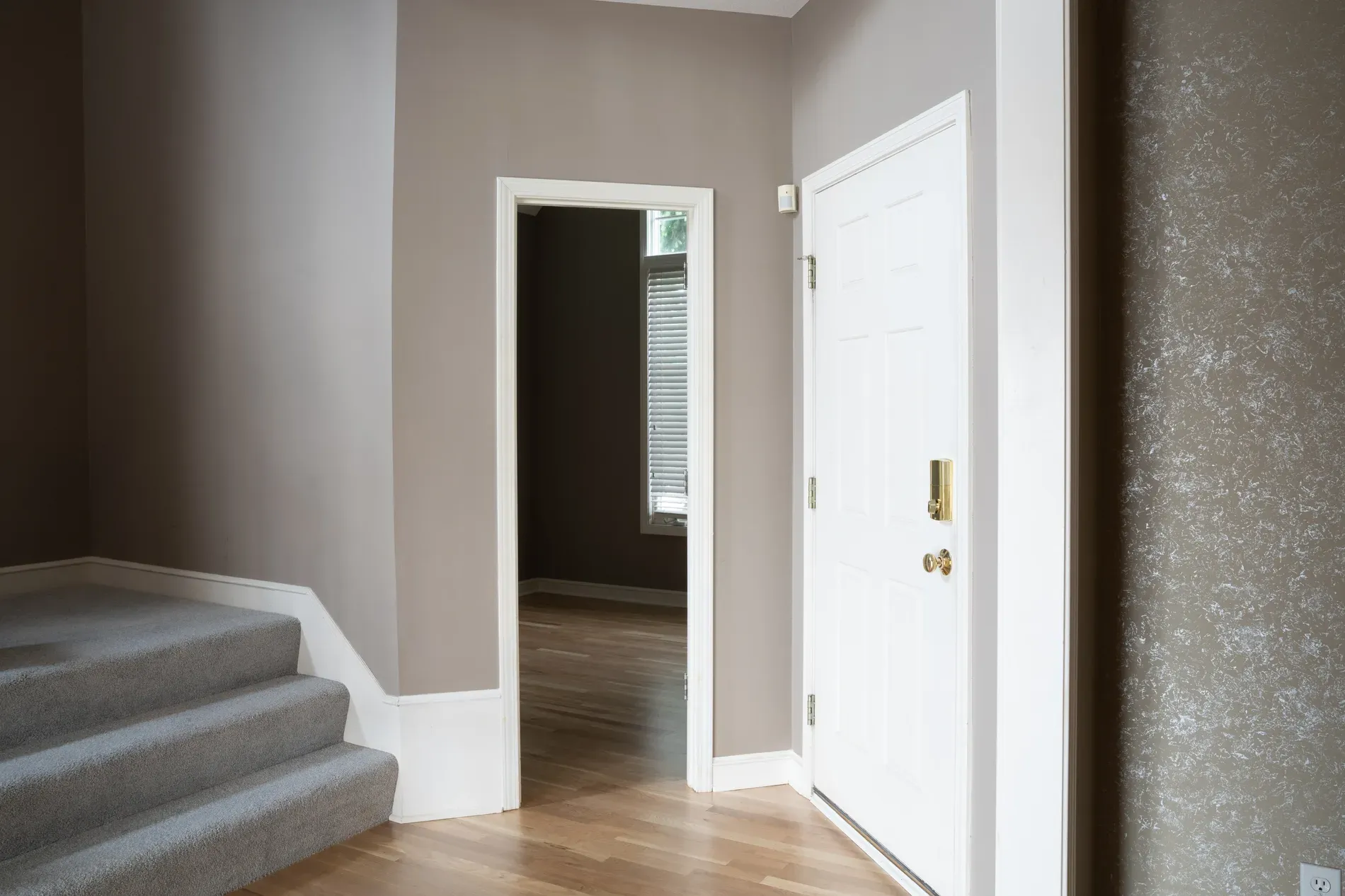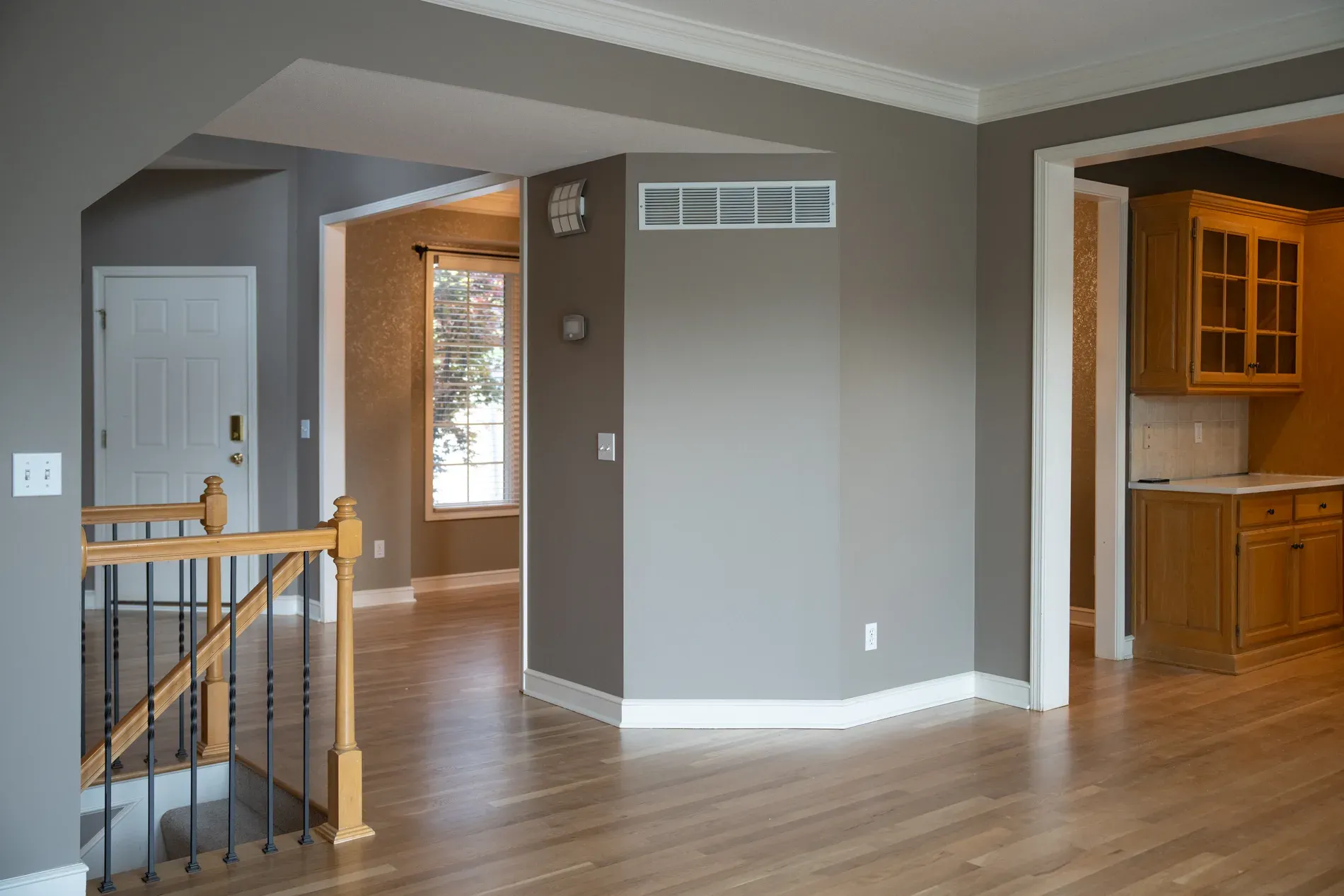
Finished basements are everywhere in Kansas City, from walkout lower levels in Olathe and Lee's Summit to the rec rooms under older homes in Brookside and Liberty. Sooner or later most owners ask the same thing: can the wood floor upstairs keep going downstairs? The short answer is that hardwood floors in a basement can work, but only the right kind of hardwood, installed the right way, over a slab that has been tested first. Get any of those wrong and the floor tells you within a season.
Why a Basement Is Different
A basement floor is a concrete slab poured on the ground, and that ground holds water. Concrete is porous, so moisture moves up through it all the time, even when the surface looks and feels dry. The walls are in contact with soil too. On top of that, basements in our climate run cool and damp in summer, when humid air drifts down the stairs and meets cold concrete.
Wood takes on moisture from whatever it sits on and from the air around it. A floor on the main level sits over a wood subfloor in conditioned air. A floor in the basement sits on a damp, cold surface that never fully dries. That difference is the whole story.
Solid Hardwood: Not on the Slab
Solid hardwood does not belong directly on a basement slab. It cannot be nailed into concrete, and a solid board taking on moisture from below swells on the underside first. That is the recipe for cupping, and in a bad case, boards lifting right off the floor. Cupping and crowning explains what that looks like and why it happens.
Solid wood can go into a basement over a properly built wood subfloor system on top of the slab, with a moisture barrier underneath it. That adds cost and takes ceiling height, which many basements do not have to spare. It is an option for some homes, not a default.
Engineered Hardwood: The Usual Answer
Engineered hardwood is a real wood top layer bonded to a cross-layered core. That core resists the swelling and shrinking that wrecks solid boards, and many engineered products are rated by their manufacturer for installation below grade, over concrete. That rating matters. If the product is not approved for basements, it does not go in one.
Engineered flooring is installed over a slab in one of two ways:
- Glued down. The boards are bonded straight to the concrete with an adhesive rated for it, often one that also acts as a moisture barrier. This feels the most solid underfoot and sounds the most like a traditional floor.
- Floating. The boards lock or glue to each other and rest on an underlayment with a vapor barrier, without being fastened to the slab. This can suit a slab where the owner wants to avoid adhesive on the concrete, as long as the slab is flat enough for the product.
The full comparison, including why the thickness of the wear layer matters for future refinishing, is in solid or engineered hardwood. If you want the option to sand the basement floor someday, buy the thicker wear layer. Can engineered hardwood be refinished covers that in more detail.
The Moisture Test Comes First
Before any wood goes on a basement slab, the concrete gets tested. This step is not optional, and it is the one most often skipped when a floor fails. Slabs vary a lot from house to house, and even from one corner of a basement to another.
- Slab moisture testing. The common methods are an in-slab relative humidity test, where probes are set into small holes drilled in the concrete, and a calcium chloride test, which measures how much moisture comes off the surface over a set time. The flooring and adhesive manufacturers state the limits their products can handle.
- Flatness. Basement slabs are rarely flat. High spots get ground down and low spots get filled, because engineered flooring over a wavy slab will flex, click and come loose.
- A look at the history. Water stains on the walls, white mineral deposits on the concrete, a musty smell, or a sump pump that runs often all point to a basement that is not ready for wood yet.
A slab that reads high is not necessarily the end of the plan. A moisture barrier system or the right adhesive can handle some moisture. A slab that is actively wet, or a basement that takes on water after heavy rain, needs a waterproofing or drainage fix first, and no flooring choice gets around that.
Keeping the Air in Check
Most wood flooring manufacturers ask for indoor humidity of roughly 30 to 50 percent. Upstairs, central air usually handles that. Basements often run higher in summer because they are cooler and the air conditioning does not reach them as well. A dehumidifier, and enough supply air to keep the space conditioned like the rest of the house, is part of putting wood down there. In winter the opposite happens and the air dries out, which is when gaps show. Why gaps open in winter covers that side.
When Wood Is the Wrong Call
We would rather say this up front than come back to pull up a ruined floor. Wood is a poor fit for a basement when:
- The basement has flooded before, or takes on water in heavy storms, and that has not been fixed.
- The slab tests wet and the manufacturer's limits cannot be met.
- The space is a full bathroom, laundry room or bar area where water hits the floor regularly.
- The basement is not heated and cooled with the rest of the house.
In those spaces, luxury vinyl plank is usually the more practical floor, and it comes in wood tones close enough that the stairs and the basement still feel connected. Hardwood vs luxury vinyl plank lays out the tradeoffs room by room.
Matching the Floor Upstairs
The basement floor is usually separate from the main level, with the stairs between them, so it does not have to match exactly. Many people choose an engineered floor in the same species and a similar color as upstairs, so the house reads as one. If the stairs are getting new treads or a refinish at the same time, that is a good moment to tie the color together. Refinishing hardwood stairs explains how that works.
Talk It Through Before You Buy
The most expensive basement floor is the one that has to come back out. If you are finishing a lower level or replacing carpet downstairs, we can test the slab, look at the conditions and tell you plainly whether engineered wood will hold up or whether another floor makes more sense. We install across the metro, including Olathe, Lee's Summit, Overland Park and Liberty. See our hardwood floor installation service, then get a free estimate.
Get a Free Estimate
Have a floor you want looked at? We give honest, no-pressure estimates across the Kansas City metro.