Mission Hills was planned before most of the houses in it were built. J.C. Nichols began planning and platting it in 1914 as part of his Country Club District, and the homes went up mostly in the 1920s and 1930s, many of them designed by named architects such as Clarence E. Shepherd, Edward Tanner and Edward Buehler Delk. Belinder Hills, Indian Hills and Sagamore Hills fill out the rest of the city.
That history is why a question about hardwood floor refinishing in Mission Hills is different from the same question in a newer suburb. The floors here are usually original. They were put down by hand when the house was built, and they have been living with it for close to a century. Done right, the work keeps that. Done carelessly, it cannot be undone.
An Original-Wood Town
Houses from this era were built with solid oak floors as a matter of course, and in the larger homes the flooring tends to match the ambition of the millwork around it. Depending on the house you may find plain oak strip in the bedrooms and something more deliberate in the formal rooms: quartersawn boards, a contrasting border around the edge of a living room, or a pattern in an entry hall. Upstairs floors and back halls are often simpler than the rooms guests saw.
Knowing which is which matters, because a border or a pattern has to be sanded differently from straight strip. Boards running in different directions cannot all be sanded with the grain in one pass, and a floor like that is where a rushed crew leaves cross-grain scratches that show under every lamp. How that part of the work is done is covered in hardwood floor sanding.
Measure Before Anyone Sands
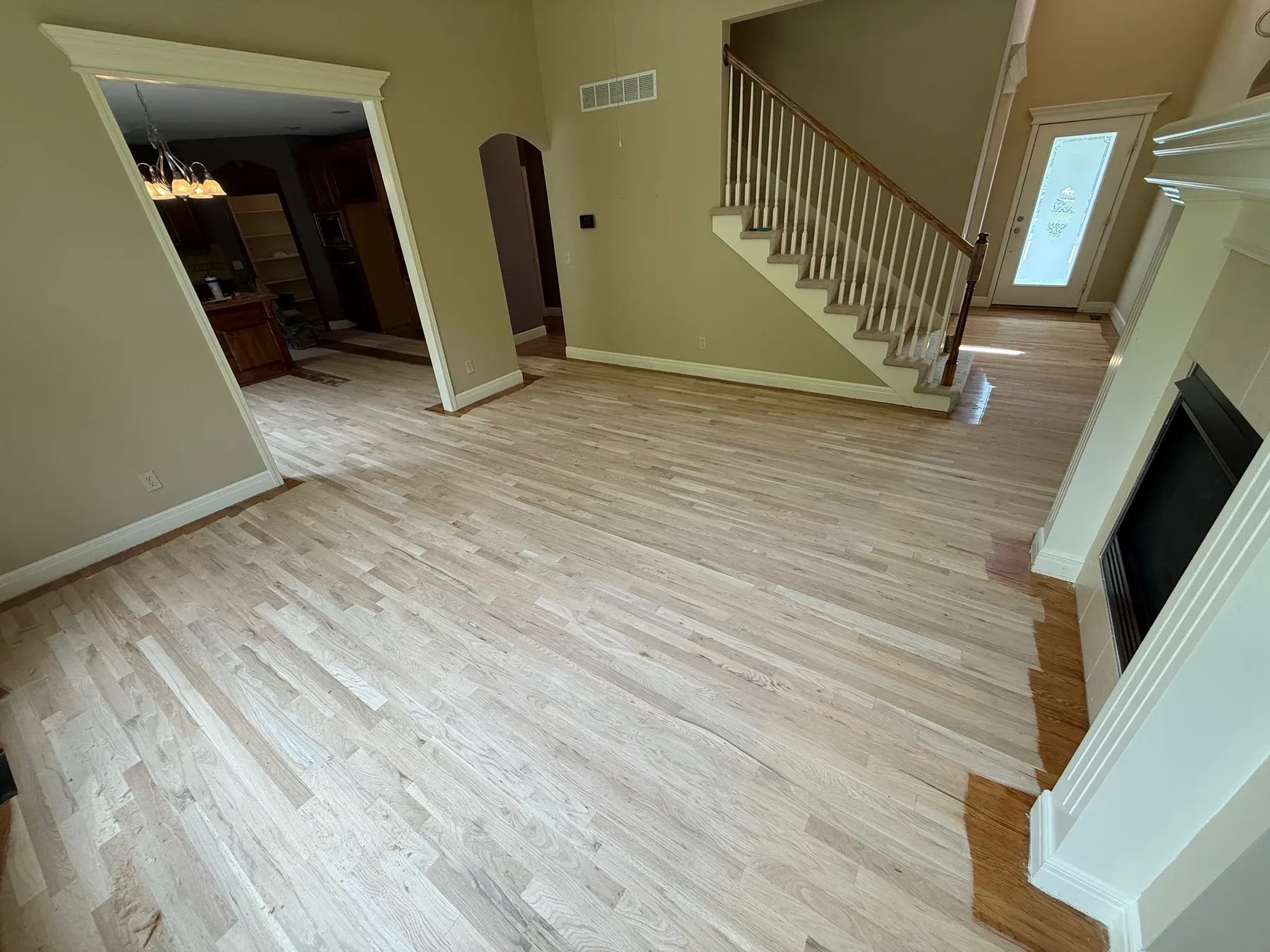
A solid floor can only be sanded so many times, and a floor from the 1920s may have been sanded several times already. Before we talk about color or schedule we find out how much wood is left above the tongue, usually by lifting a floor register or looking at a board end at a threshold. That one measurement decides whether a full sanding is safe, whether it has to be a very light one, or whether the floor should not be sanded at all.
We wrote about exactly this for the same generation of houses just east of the state line, in how many sandings a century-old floor has left. The advice carries straight across to Mission Hills. Sanding is a one-way decision, so it is worth being slow about it.
When a Full Sanding Is Not the Answer
Plenty of old floors do not need to go back to bare wood. If the existing finish is sound and only worn at the surface, a screen and recoat renews it without removing any wood at all. On a floor with limited wear layer left, that is often the most responsible choice, and it can be repeated every few years to keep the floor from ever needing another full sanding.
The catch is the finish that is already there. Floors of this age were often finished with shellac or varnish and kept up with paste wax, and some still carry a waxed surface. New polyurethane will not bond over wax, so a waxed floor cannot simply be recoated. It has to be tested first, and if wax is present the choice is between staying with a wax-maintained finish or sanding to clean wood. We test before we promise either one. How often to refinish or recoat covers the difference between the two jobs.
What a Century Leaves Behind
Very few floors in these houses have made it this far untouched. The usual history shows up as soon as the rugs come up:
- Old patches. Plywood or mismatched boards where a floor register, a radiator or a wall used to be.
- Dark stains. Water rings from radiators and plants, and pet stains that went into the wood rather than the finish.
- Face nails and filler. Earlier repairs to loose boards, some of them visible, some hiding a squeak that came back. Squeaky hardwood floors covers the right way to fix those.
- Kitchens and baths that were redone. Where the original floor stops at a newer kitchen, there is often a threshold strip or a height change that nobody loved.
Most of this is fixable, and fixing it before the floor is sanded is what makes the repairs disappear. Stained or damaged boards are cut out and replaced with oak of the same species, width and thickness, woven in at staggered lengths so there is no straight seam. Where reclaimed boards from a closet or a hidden area can be used, the match is closer still. Patching an old floor without a visible seam goes into how that is done, and restoring old and damaged floors covers what usually comes back and what does not.
Choosing a Color for an Old House
Color in a house like this is a question about the rest of the room. Oak floors of this era were commonly finished in warm, medium tones that sat comfortably beside stained trim and paneling, and a floor refinished very pale or very gray can look like it came from a different house. That does not mean you have to go traditional. It means sampling on your own sanded boards, in the room, next to the trim, before deciding. The staining guide walks through how we do that.
The clear coat matters too. An oil-based finish deepens to amber over the years, which many owners of older homes like. A water-based finish stays closer to the color on the day it was applied. Neither is wrong, and water-based or oil-based polyurethane lays out the trade-offs.
Protecting the Rest of the House
In a Mission Hills home the floor is rarely the only fine woodwork in the room. Baseboards, door casings, built-ins and stair parts are often original too, and they are harder to replace than the floor. We protect them through the work, and we run dustless sanding so the fine dust that sanding makes does not settle into the plaster, the millwork and the rest of the house.
The staircase deserves its own conversation. Treads that match the floor can be refinished with it, and older railings can be restored rather than replaced. Our guide to hardwood stairs and stair treads covers that part of the house.
Adding New Wood to an Old Floor
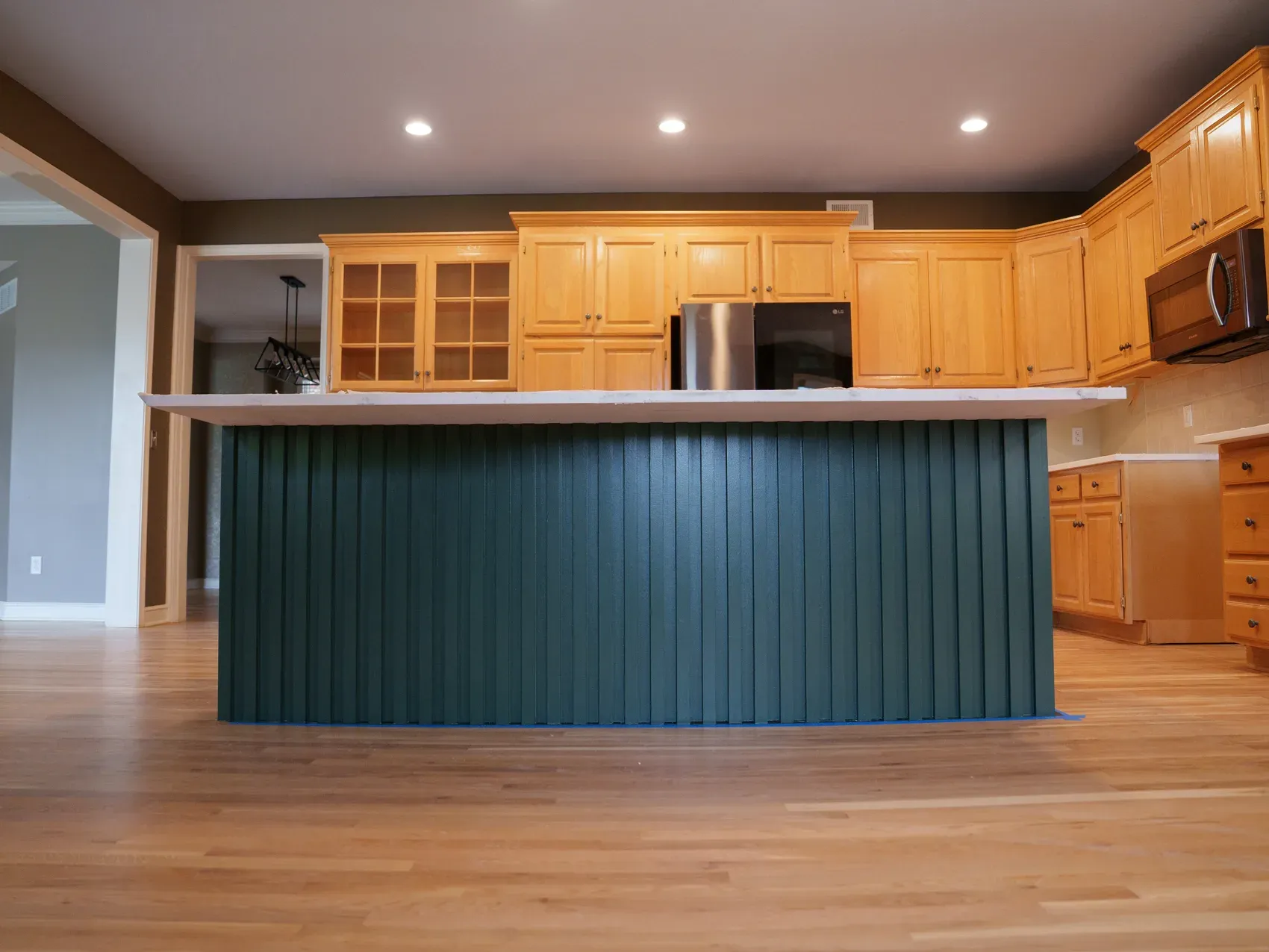
The other common job here is extending the original floor: into a renovated kitchen, across an opened-up wall, or into an addition. New oak can be woven into old so that once both are sanded and finished together the floor reads as continuous. What cannot be fully matched is age. New wood takes stain a little differently from wood that has been in the house since the 1920s, and a medium tone hides that better than a very light natural finish. We show you both before you commit. Our hardwood floor installation in Mission Hills page covers the install side.
The Climate Still Applies
A floor that has lasted a century in Kansas City has done it by moving with the seasons: humid summers, and furnace-dried winters when gaps open between boards. That movement is normal, and it is the reason we do not fill every winter gap solid or pack new boards in tight. Why gaps open every winter explains what is normal and what is not. Keeping indoor humidity steady does more for an old floor than almost anything else an owner can do.
Working in Mission Hills
We refinish, repair and add to original floors across Mission Hills and the neighboring Country Club District streets in Kansas City, Prairie Village and Leawood. Our hardwood floor refinishing in Mission Hills page covers the service. If you want to know how much life an original floor has left and what it would take to bring it back, get a free estimate. We will measure the wood first and tell you plainly what the floor can take.
Get a Free Estimate
Have a floor you want looked at? We give honest, no-pressure estimates across the Kansas City metro.