Blue Springs and Lee's Summit sit side by side on the east side of the metro, and they share a lot of housing. Blue Springs was incorporated in 1880, but it grew almost entirely in the second half of the twentieth century, from about 2,500 people in 1960 to nearly 26,000 by 1980 and more than 58,000 by the 2020 census. Lee's Summit has an older core, with a downtown listed on the National Register of Historic Places, surrounded by decades of newer family neighborhoods and developments like New Longview, built from 2004 on part of R.A. Long's old Longview Farm.
So when someone asks about wood floor refinishing in Blue Springs or Lee's Summit, we are usually talking about one of three floors, and each one needs a different conversation.
The Three Floors We Find Out Here
Oak in a 1970s or 1980s house. Split-levels, ranches and early two-stories from the growth years often had carpet in the living areas and bedrooms, with hardwood, if any, in the entry, kitchen or dining room. Some have solid oak under the carpet as well. Pull back a corner in a closet before assuming either way.
Builder-installed oak in a 1990s or 2000s two-story. A very common floor on this side of town: red oak running through the entry, kitchen and breakfast area and sometimes a great room, with carpet on the stairs and upstairs. It often carries an amber finish that has yellowed further with age, and the traffic lanes from the garage door to the kitchen sink are worn through.
Prefinished or engineered flooring in newer builds. Recent subdivisions tend to use factory-finished boards, often engineered, in wider widths and lighter colors. Those floors need a different approach, covered below.
The older blocks near downtown Lee's Summit are the exception. Original wood there follows the same rules as the century-old floors in Brookside and Waldo.
Builder Oak Is Better Than It Looks
Builder grade gets said like an insult. For the wood itself it mostly is not. If the floor is solid oak, and in houses of this age it usually is, it is the same material we would install today, and a floor that has been down for twenty or thirty years has usually been sanded rarely or never, so most of its wood is still there.
What makes these floors look tired is almost always the finish: worn through in the lanes and yellowed everywhere else. That is good news, because the finish is the inexpensive part to replace. Before anyone talks about new flooring, establish whether you have a finish problem or a wood problem. The refinish or replace guide covers how to tell.
Recoat, or Sand to Bare Wood?
These are two different jobs, and the right one depends on what you want to change.
If the finish is dull and scratched but has not worn through to bare wood, and you like the color, a screen and recoat brings it back for a fraction of the cost of a full refinish. A busy family floor that gets recoated every few years can go a very long time between sandings.
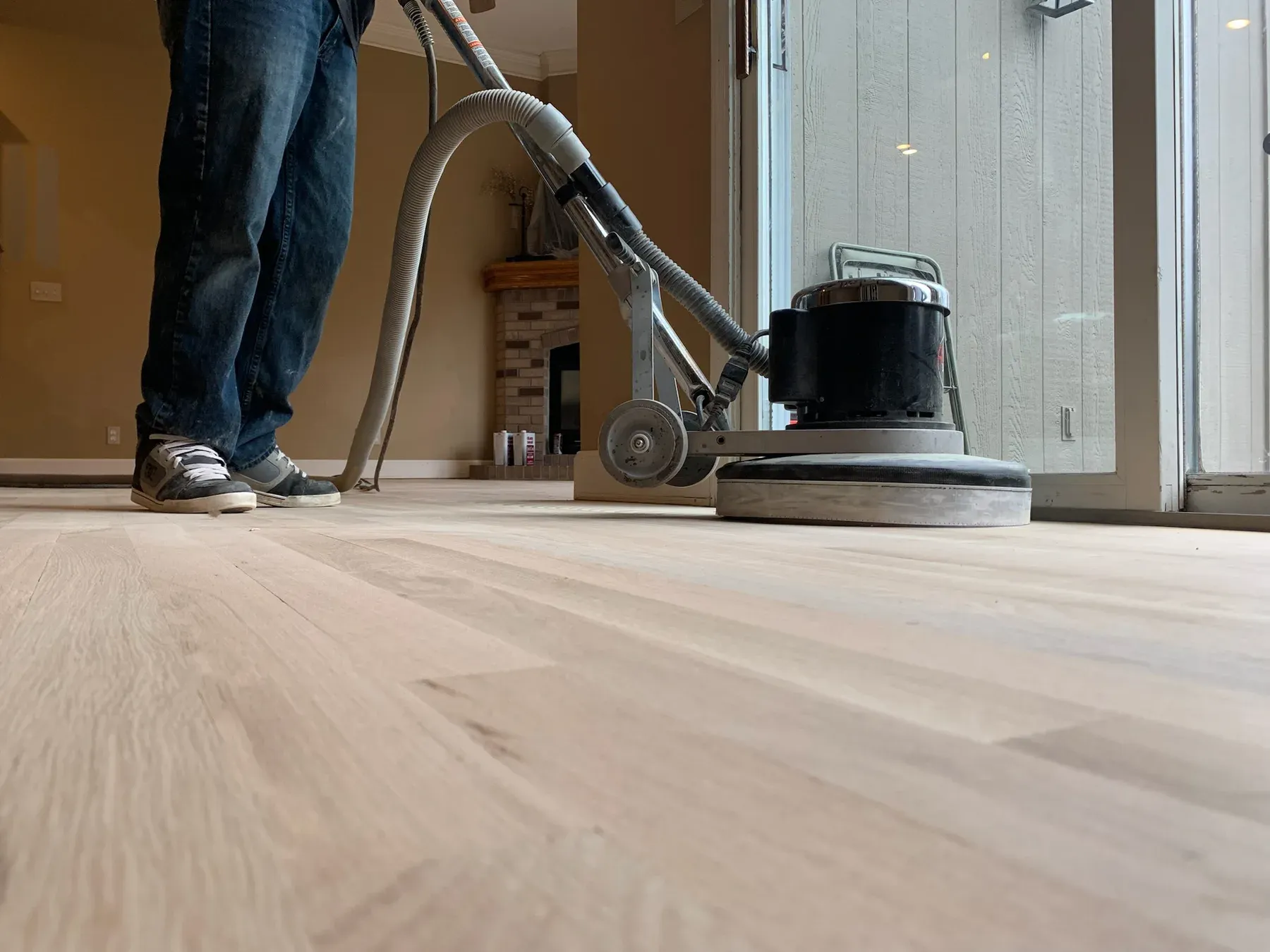
If the lanes are gray and worn through, the boards are dented and deeply scratched, or you are simply done with the yellow color, the floor needs sanding to bare wood. That is where the real transformation happens. Our refinishing in Blue Springs and refinishing in Lee's Summit pages cover the work, and the scratch repair guide explains which marks come out with which job.
One thing to check first: a recoat only bonds to a clean finish. Floors that have been treated with polishes or shine restorers from the store often will not take a new coat, which is something we test before quoting.
Getting Rid of the Yellow
This is a very common request in these houses, and it is achievable with realistic expectations. Once the old finish is sanded off, red oak can go natural, warm brown, deep espresso or anywhere in between. What red oak resists is cool gray and very pale finishes, because its natural pink undertone shows through and turns them muddy. Getting close takes extra steps and careful sampling.
If a pale, neutral floor is the goal, see samples on your own sanded boards before committing, and it is worth knowing why most of the lighter floors in new model homes are white oak. The white oak guide explains the difference, and the staining guide covers how we test colors.
The finish itself matters in a family house too. A water-based finish stays clear and will not yellow the way the old amber finish did, and a satin or matte sheen hides the everyday scratches from kids, dogs and kitchen chairs far better than gloss.
Running the Oak Further When the Carpet Comes Out
In a lot of these houses the oak stops at the edge of the family room or the bottom of the stairs, and a refinish is when people decide to pull the carpet and run wood through. It can be done so the old floor and the new one read as one.
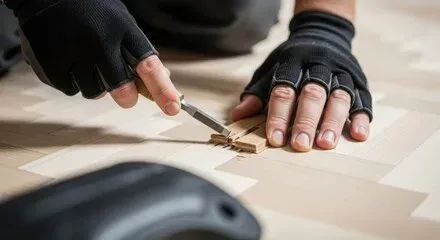
The new boards have to match the species, width and thickness of the existing oak, and they get woven into the old boards rather than butted against them in a straight line. Then the whole connected area is sanded and finished together so the color and sheen are identical. We walk through that in matching new hardwood to an existing floor. The key is sequencing: the new boards go in before the sanders arrive, not after.
If the existing floor is prefinished, a seamless extension is harder, because the boards have beveled edges and a factory color that may no longer be made. If the boards are solid, one answer is to sand everything and finish it on site, though the bevels can still show. Another is a clean transition at a doorway. It depends on the product, so ask before the carpet is gone.
Stairs in a Two-Story
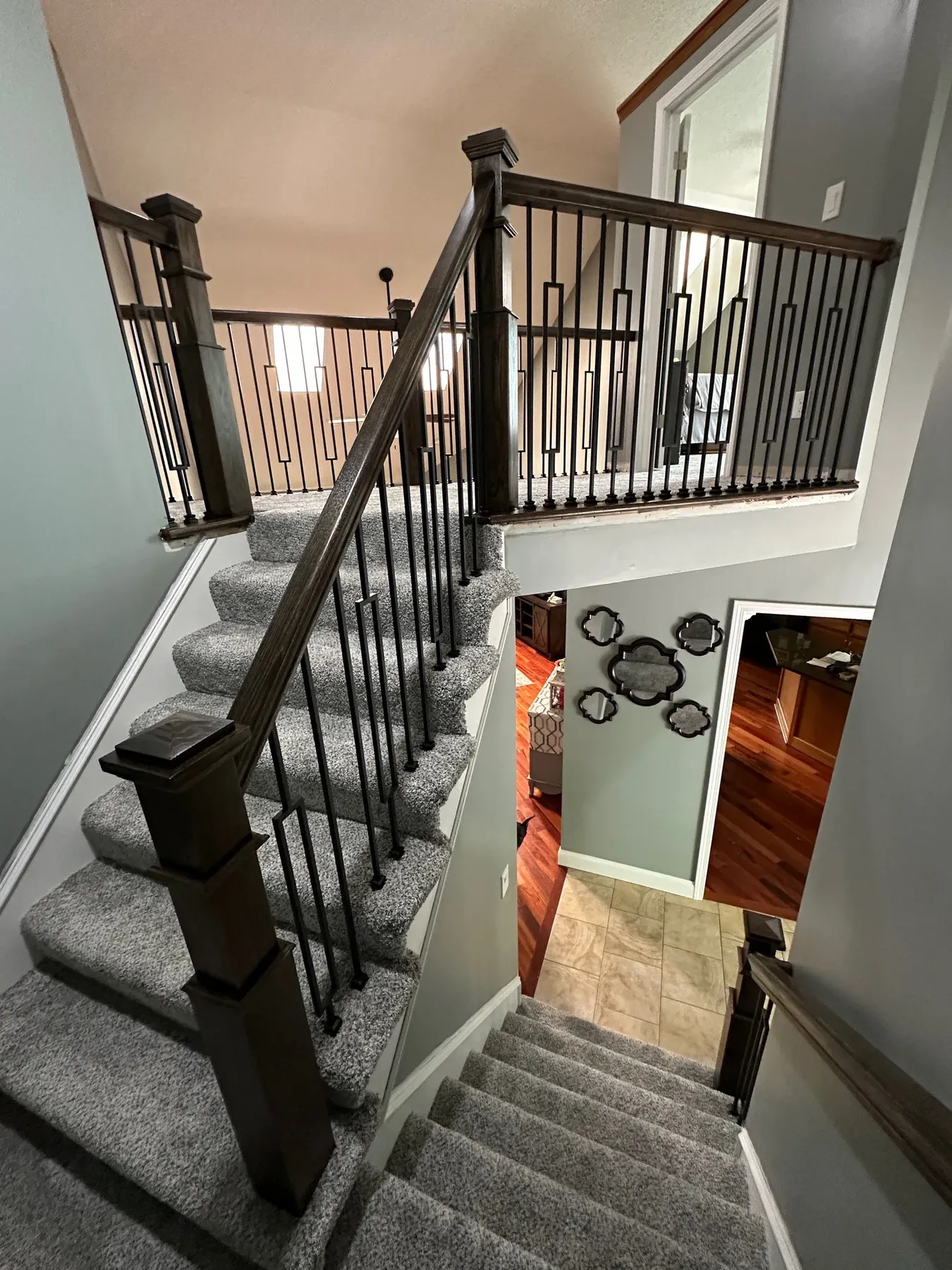
The typical staircase in these houses is carpeted, often with stained wood rails and iron or wood balusters, like the one pictured at the top of this page. Replacing that carpet with hardwood treads and risers that match the refinished floor changes how the whole house reads when you walk in.
It is its own piece of work. Stairs built to be carpeted usually have rough treads that were never meant to be seen, so they get replaced or capped with solid wood, the nosings and returns have to be built properly, and the finish has to match the floor it meets. The hardwood stairs guide covers what is involved, and our hardwood stairs in Lee's Summit page has the service detail.
Newer Builds and Engineered Floors
Newer homes, whether in New Longview or the recent subdivisions around Blue Springs, are more likely to have engineered or prefinished flooring. Two questions decide what can be done with them.
First, how thick is the real wood wear layer? A thick wear layer can be sanded and refinished like solid wood. A thin one cannot be sanded without breaking through, which leaves recoating as the main option. Can engineered hardwood be refinished explains how to find out what you have.
Second, is the floor over concrete? Finished basements sit on a slab, which rules out nailed solid wood for any extension down there and points toward engineered material. The solid or engineered guide covers that choice.
Busy Houses, Durable Floors
These are family neighborhoods, and the floors take real traffic along the path from the garage, through the kitchen and out the back door. A few habits keep a refinished floor looking good far longer.
- Mats at the garage and patio doors. Grit carried in on shoes does more damage than anything else.
- Felt pads on chairs and stools. Replaced when they wear through or pick up grit.
- A pH-neutral wood floor cleaner. Not steam mops, not vinegar, not oil soaps. The cleaning guide explains why.
- A recoat before the finish wears through. Renewing a finish every few years costs far less than sanding a floor that has gone gray in the lanes.
If there are dogs in the house, the dogs and hardwood guide is worth five minutes.
Where We Work on the East Side
We refinish, repair and install hardwood across Blue Springs and Lee's Summit, from the older streets near downtown Lee's Summit to the newer neighborhoods on the edges of both cities. Our installation in Blue Springs page covers new floors and extensions. If you have a tired oak floor and want to know whether it needs a recoat, a refinish or something more, get a free estimate and we will give you a straight answer.
Get a Free Estimate
Have a floor you want looked at? We give honest, no-pressure estimates across the Kansas City metro.